MIB Talk on Design, Playfulness and Risk That Activates the Brain
Topic
20. 11. 2025

We need to create elements in public space that capture our attention, make us stop, and prompt us to think. Change pulls us out of routine, develops our brain and fosters relationships between people who otherwise would have no reason to interact.
Such design elements and objects are created by the guests of the next MIB Talk, Danica Pišteková and Matěj Hájek. The theme of the November event at TU-BA was “design that activates the city” (urban playscapes). The event was moderated by MIB director Petra Marko, with MIB City for Children programme lead Sandra Štasselová as the third guest.
Slovak designer Danica Pišteková creates unconventional and playful objects primarily from wood, together with her former classmates from university, with whom she founded the studio Woven.
In her work, interactivity and mobility of objects are especially important. “These are movable elements or objects on wheels that people can interact with in various ways and move around, creating stimulating situations,” she explains.
Examples include the circular and modular seating “Nová terasa” (New Terrace) at the Goethe-Institut, a sauna on wheels, or the stage with a pit “Pod Tým Nad Tým” in Banská Štiavnica.

Nová terasa, author and photo: Danica Pišteková
Difference Trains Our Brain
“The goal is for visitors to have an experience of the space they are in,” says the designer, explaining that this can also be achieved by creating an object that unsettles people. For example, the installation “The Doors” at the Pohoda Festival consisted of a frame with twenty different collected doors. “People were unsettled – they suddenly didn’t know where they entered and where they should exit.” According to Danica Pišteková, objects that are not obvious at first glance, that do not immediately show how they should be used, motivate people to think about things differently.
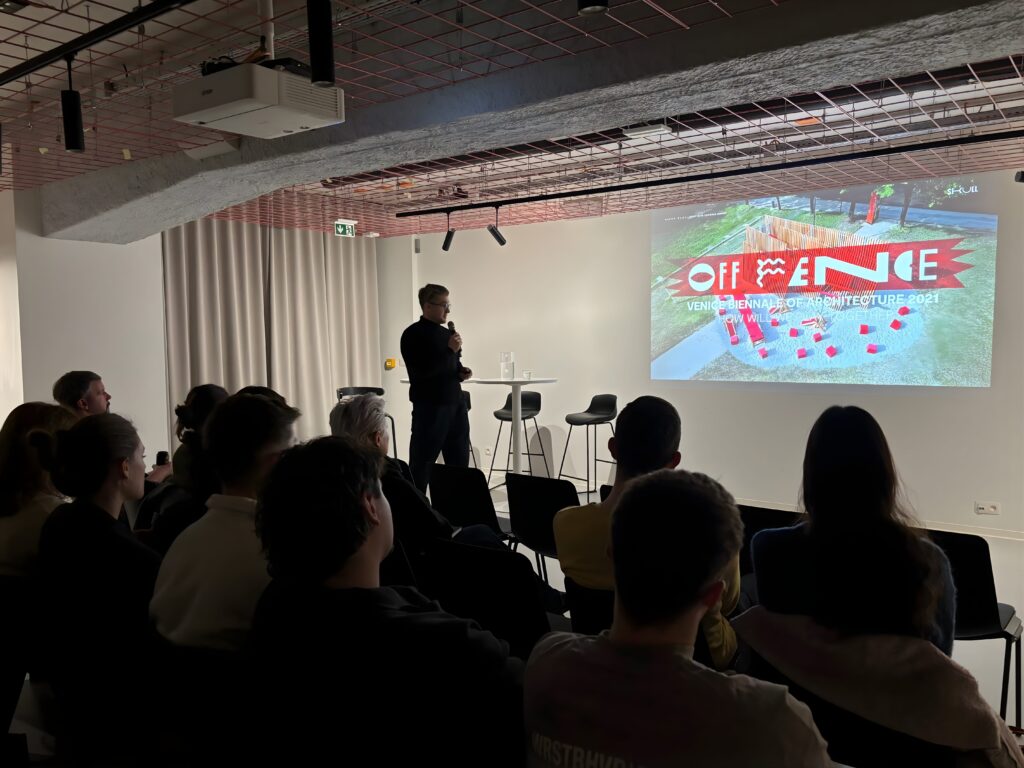
Sculptor, Prague-based designer, and neuroscience enthusiast Matěj Hájek from Studio SKULL explains that the goal of such objects is, among other things, to train the brain. “Neurons that fire together, wire together,” he paraphrases neurologist Donald Hebb. “Children do this automatically, but the older we get, the more we lose this ability and must actively seek it out,” he emphasizes. According to Hájek, this is what objects that engage the senses provoke, and exist somewhat on the edge. A good example is the installation “Off Fence” from the Venice Architecture Biennale. The object – originally a fence that obstructs – gradually transforms into a shared table, a symbol of community. The work used a system of tilting planes and challenged participants’ balance.

“We spend most of our time devoting 20% of our attention to sensory information and 80% to imagination. But when we stumble, that flips, and our brain suddenly fully perceives its surroundings through all senses – it is present.” To avoid premature aging, it is good to create risky situations that invite us to step out of our comfort zone. That, too, is what playfulness is about.
Going Outside and Being with Others
It’s not just about training the brain, but also the body. We need to get children and young people – and adults too – away from screens.
According to the guests, playgrounds are an ideal place to start. “A playground is a natural center of life in any neighborhood, because children spend a lot of time there and are usually not alone – an adult is often with them. Thanks to that, people can meet,” explains Matěj Hájek.
Playgrounds don’t have to be catalogue-based—they can look different, be a work of art, a sculpture, adventurous spaces, the guests agreed. At the same time, they acknowledged that a challenge lies in creating elements that are accepted by certifiers and municipalities.
A good example in Bratislava is Šantisko at Kamzík, created by Mestské lesy (City Forests), whose wooden elements were made from local wood by forest employees themselves and subsequently certified. Šantisko is expected to gradually expand.
Sandra Štasselová, lead of the City for Children programme at the Metropolitan Institute of Bratislava, also a guest at the MIB Talk, explains why it is important to come up with engaging ideas: “To go outside, you need a reason, and for most children at a certain age, that reason is friends. And to make friends, you need something that brings you together.”
That’s why the City for Children programme introduced the idea of “Play Boxes”—simple boxes containing a variety of play and sports equipment. Thanks to an open call, play boxes were placed in the courtyards of twenty communities, which used and cared for them over the summer.
“Everyone has a badminton racket at home, but not everyone has a friend in the courtyard to play badminton with at 10:30 on a Saturday,” Sandra Štasselová explains. The play box attracts children; they explore what’s inside together, start talking about it, and play together. That’s how friendships form.
How to Engage Young People
Another challenge is creating spaces that draw teenagers and young people outside. Designer Danica Pišteková, who is also a lecturer at the Academy of Fine Arts and Design, has created several such objects. She found that the most successful ones were slightly on the edge of the city, in dimly lit areas, where there were fewer adults. For example, the wooden dish-shaped object “UWO” in Piešťany, where young people would sit for hours.
“Of course, it also brought controversy – some people didn’t like it, there was litter and dirt, the work wore down over time and eventually disappeared, but that’s natural. Some projects unite a community through shared use, and sometimes a community unites against them,” she adds.
Danica emphasized that their interventions also function as “testing laboratories for the public”- temporary objects through which community behavior and real spatial needs can be observed.
At Woven workshops, people create unconventional wooden objects together – over ten days, the participant community must come together to create a piece. In the end, that’s what it’s all about: the community.
What we need today is to create opportunities for people to stop, meet, get to know one another, and grow together. Design has that power.

PHOTO: Danica Pišteková (Woven), Matěj Hájek (SKULL), and MIB
Share with friends:


